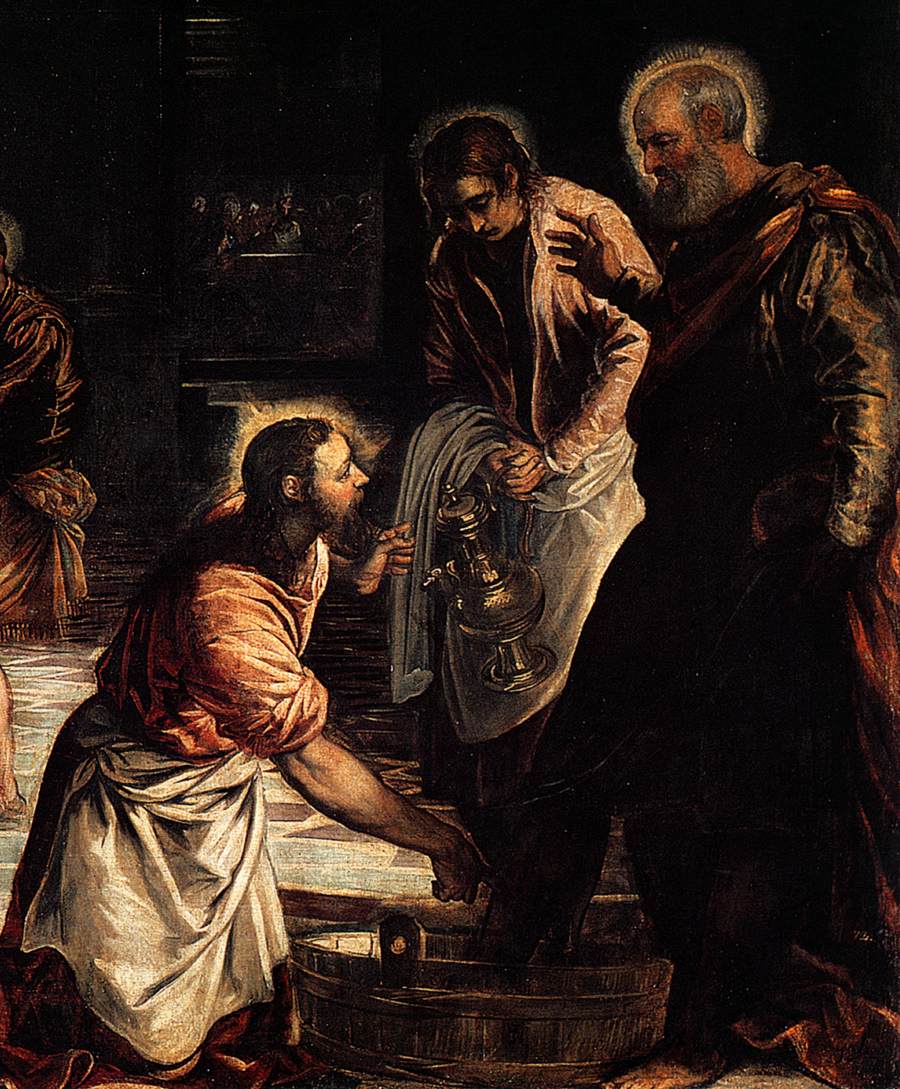
Christ Washing the Feet of His Disciples (detail), Tintoretto, c,1547
Readings for the Evening Mass of the Lord's Supper (New American Bible: Philippines, USA)
Gospel (John 13:1-15. RSV-Catholic Edition)
Now before the feast of the Passover, when Jesus knew that his hour had come to depart out of this world to the Father, having loved his own who were in the world, he loved them to the end. And during supper, when the devil had already put it into the heart of Judas Iscariot, Simon's son, to betray him, Jesus, knowing that the Father had given all things into his hands, and that he had come from God and was going to God, rose from supper, laid aside his garments, and girded himself with a towel. Then he poured water into a basin, and began to wash the disciples' feet, and to wipe them with the towel with which he was girded. He came to Simon Peter; and Peter said to him, "Lord, do you wash my feet?" Jesus answered him, "What I am doing you do not know now, but afterward you will understand." Peter said to him, "You shall never wash my feet." Jesus answered him, "If I do not wash you, you have no part in me." Simon Peter said to him, "Lord, not my feet only but also my hands and my head!" Jesus said to him, "He who has bathed does not need to wash, except for his feet, but he is clean all over; and you are clean, but not every one of you." For he knew who was to betray him; that was why he said, "You are not all clean." When he had washed their feet, and taken his garments, and resumed his place, he said to them, "Do you know what I have done to you? You call me Teacher and Lord; and you are right, for so I am. If I then, your Lord and Teacher, have washed your feet, you also ought to wash one another's feet. For I have given you an example, that you also should do as I have done to you.
AN SOISCÉAL (Eoin 13:1-15. Bíobla Mhaigh Nuad ) [Irish language]
Roimh fhéile na Cásca, ó bhí a fhios ag Íosa go raibh a uair tagtha chun imeacht as an saol seo go dtí an tAthair, agus ó thug sé grá dá mhuintir féin a bhí ar an saol, thug sé grá thar na bearta dóibh feasta.
Le linn an tsuipéir agus tar éis don diabhal a chur ina chroí ag Iúdás, mac Shíomóin Isceiriót, go mbraithfeadh sé é – ó bhí a fhios ag Íosa go raibh gach uile ní tugtha isteach ina lámha dó, ag an Athair, agus gur ó Dhia a ghabh sé amach, agus gur ar Dhia a bhí a thriall, d’éirigh sé ón suipéar, agus leag sé uaidh a chuid éadaigh, agus cheangail sé tuáille faoina choim. Ansin chuir sé uisce sa bháisín agus thosaigh ag ní cosa na ndeisceabal agus á dtiormú leis an tuáille a bhí faoina choim.
Tháinig sé chomh fada le Síomón Peadar agus dúirt seisean leis: “Tusa a ní mo chos-sa, a Thiarna!” D’fhreagair Íosa é: “Ní fios duit anois cad tá ar siúl agam,” ar sé leis, “ach tuigfidh tú ar ball é.” Dúirt Peadar leis: “Ní nífidh tú mo chosa-sa choíche!” D’fhreagair Íosa é: “Mura ndéanfaidh mé thú a ní, ní bheidh aon chuid agat díom.” Dúirt Síomón Peadar leis: “A Thiarna, ní amháin mo chosa, ach nigh fós mo lámha agus mo cheann!” Dúirt Íosa leis: “Duine tar éis a fholctha, ní gá dó a ní [ach a chosa]; tá sé glan go hiomlán. Agus tá sibhse glan, ach níl gach duine agaibh glan.” Mar bhí a fhios aige cé a bhí chun é bhrath; sin é an fáth a ndúirt sé: “Níl gach duine agaibh glan.”
Ansin, tar éis dó a gcosa a ní, agus a chuid éadaigh a chur air, shuigh sé chun boird arís agus dúirt sé leo: “An dtuigeann sibh cad tá déanta agam daoibh? Deir sibh: ‘A Mháistir’ liom agus ‘A Thiarna’, agus is le ceart é, óir is mé sin. Má rinne mise bhur gcosa a ní agus gur mé bhur dTiarna agus bhur Máistir, ba chóir daoibhse chomh maith cosa a chéile a ní. Tá sampla tugtha agam daoibh, faoi mar atá déanta agam daoibhse, go ndéanfadh sibhse mar an gcéanna.
+++
When I see Jesus washing the feet of the apostles, done on the occasion of his instituting the Holy Eucharist, the Mass, I think of Marilyn, one of those who attends my weekday Masses and whose husband Ramonito was incapacitated by a stroke nearly two years ago, and of the loving care she shows him every day although he cannot respond.
I remember my late father who, before he went to work on building sites each day went to early Mass and then came home to prepare my mother's breakfast and bring it to her in bed.
I think of the Capuchin Tertiary Sisters of the Holy Family who welcome young girls who have been traumatized to Holy Family Home here in Bacolod City. I think of the girls themselves, with whom I celebrate Mass most Sundays, and how they welcome a newcomer and stay with a girl full of anger and maybe despair until she begins to see the hope that Jesus offers.
I think of Columban Father Tony Kelly whose obituary I posted here the other day and what the writer said about him: 'in his typical quiet, unobtrusive fashion, provided many small but essential services for his fellow-Columbans in the Retirement Home'.
I think of the Columban priests, and many others, who were jailed in China after the Communist takeover in 1949 before being expelled, celebrating Mass secretly in their cells with the minimum of ceremony but certain that when they said 'This is my body . . . this is my blood', the bread and wine became the Body and Blood of the Risen Lord Jesus Christ.
Fr Thomas Rosica CSB, Toronto, on Holy Thursday